
The forex market is open 24 hours a day, five days a week. That sounds like freedom, and in a way it is — you can trade before work, after dinner, or at 3 a.m. if you're that way inclined. But anyone who's sat in front of a chart at the wrong hour knows the feeling: price barely moving, spreads oddly wide, every candle a tiny doji. You're not doing anything wrong. You're just trading while the market is half asleep.
So when is the best time to trade forex? The honest answer is "it depends on what you trade," but there are some clear patterns, and once you see them you'll stop fighting the clock.
Why time of day matters at all
Forex isn't traded on one exchange. It's a network of banks, institutions and brokers around the world, and the action follows the business day as it moves from one financial centre to the next. When a major centre opens, a wave of orders arrives. More orders mean more liquidity, tighter spreads and bigger moves. When a centre closes, activity drains away.
That's why traders talk about four main sessions, named after the cities that dominate them.
The four forex sessions
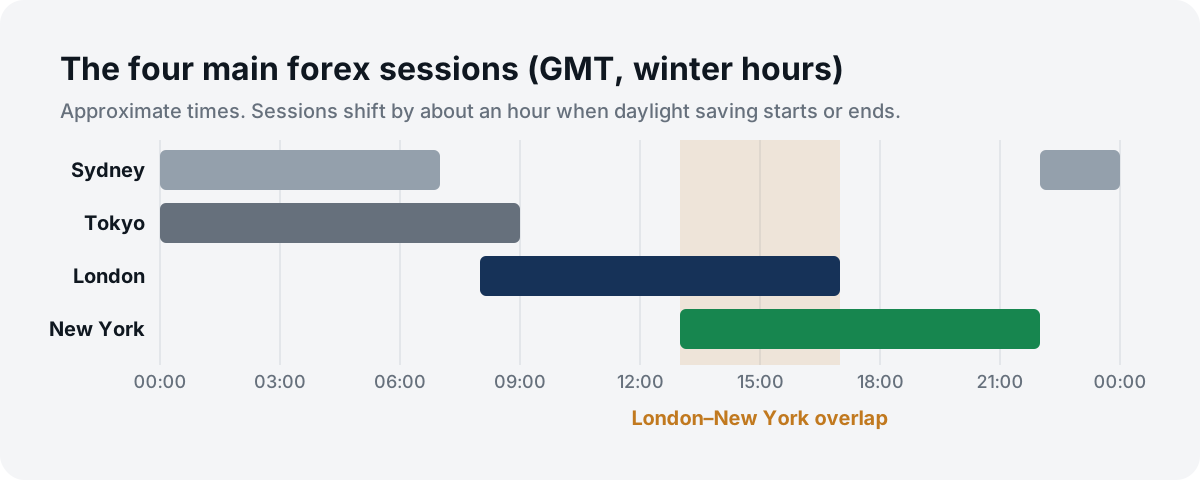
| Sydney | 22:00 – 07:00 |
| Tokyo | 00:00 – 09:00 |
| London | 08:00 – 17:00 |
| New York | 13:00 – 22:00 |
Two caveats, because session times are one of those topics where everyone's chart looks slightly different. First, these are approximate — the market doesn't flip a switch at exactly 08:00. Second, daylight saving moves things. During northern-hemisphere summer, London and New York both shift an hour earlier in GMT terms (roughly 07:00–16:00 and 12:00–21:00), and Sydney shifts the other way. Your local time zone adds another layer — in Pakistan, for example, add five hours to GMT. Set your platform's clock, or a session indicator, and check it twice a year.
Sydney: the quiet start
The week begins here, on Sunday evening GMT. It's the lightest session for most pairs. AUD and NZD pairs see the most activity, but the opening hours on a Monday can be thin, with wider spreads and occasional gaps from weekend news.
Tokyo: the Asian session
JPY pairs come alive, along with AUD and NZD. EUR/USD and GBP/USD often move in a narrow range during these hours. That's not a problem if you trade ranges — it's a frustration if you're waiting for a breakout.
London: where the volume is
London is widely seen as the largest forex trading centre in the world, and you feel it. The open often brings a sharp burst of movement as European traders react to everything that happened overnight. EUR, GBP and CHF pairs are at their most active.
New York: the second wave
US economic data is mostly released in the New York morning, and the US stock market opens a little later. USD pairs and USD/CAD are especially lively. Activity tends to fade through the New York afternoon, once London has closed.
The overlaps: where the best action usually is
The sessions overlap, and the overlaps are where liquidity stacks up.
- London–New York (around 13:00–17:00 GMT in winter). The busiest window of the day for many major pairs. Tight spreads, strong moves, lots of news. If you can only trade a few hours a day and you trade EUR/USD or GBP/USD, this is usually the one to aim for.
- Tokyo–London (a short window around 08:00 GMT). Smaller, but useful for pairs like EUR/JPY and GBP/JPY as Europe wakes up.
Match the session to the pair
The "best" time really depends on what you trade. A rough guide:
| EUR/USD, GBP/USD | London and the London–New York overlap |
| USD/JPY, EUR/JPY, GBP/JPY | Tokyo, and into the London open |
| AUD/USD, NZD/USD | Sydney and Tokyo, plus the New York data |
| USD/CAD | New York |
| Gold (XAU/USD) | London and especially New York |
Trading EUR/USD at 02:00 GMT isn't forbidden. It just means you're working with less movement and, often, less favourable spreads. Know that going in.
Times worth avoiding (or at least respecting)
- The daily rollover. Around the New York close (roughly 22:00 GMT in winter), liquidity dips and spreads can widen sharply for a few minutes. Stops placed close to price sometimes get hit right here — not by the market, but by the spread.
- Major news releases. In the minutes around big announcements — central bank decisions, US jobs figures, inflation data — spreads widen and price can jump past stops. Check an economic calendar every morning.
- Friday afternoon (New York time). Activity drains away ahead of the weekend, and positions held over the weekend can gap at the Sunday open.
- Public holidays. When London or New York is closed, volume can be very thin, and moves can be erratic.
What this means for your stop loss and lot size
Here's the part people rarely connect. The same pair moves very differently from one session to the next — and that should change where your stop goes.
A 15-pip stop on EUR/USD might be perfectly reasonable during the quiet Asian session and far too tight in the London–New York overlap. If you widen the stop to match the more active session, your lot size has to shrink to keep your risk the same:
| Asian session, 15-pip stop | $50 ÷ (15 × $10) = 0.33 lots |
| London–New York, 30-pip stop | $50 ÷ (30 × $10) = 0.16 lots |
Same $50 at risk, different session, different size. That's why we always suggest sizing from the stop, not from habit. (We explain how to choose that stop in where to place your stop loss, and the sizing formula in how to calculate forex position size.)
So, when should you trade?
The best time to trade is a session that's active for your pairs and fits your life. A brilliant session you can only reach by setting a 3 a.m. alarm will eventually lead to tired decisions. A slightly less active session you can trade with a clear head and a cup of tea is often the better choice.
Pick one or two sessions, learn how your pairs behave in them, and stick with them for a while. Consistency in when you trade makes it much easier to see whether your strategy is actually working.
Quick answers
What is the best time to trade forex?
For most major pairs, the London session and especially the London–New York overlap (roughly 13:00–17:00 GMT in winter) offer the most liquidity and movement.
What time does the forex market open on Sunday?
Trading usually resumes on Sunday evening GMT as the Sydney session begins — around 22:00 GMT in winter, depending on your broker.
Can I trade forex at night?
Yes. The market is open 24 hours on weekdays. Just expect lighter movement on many pairs and choose pairs that are active during those hours.
Is the Asian session good for beginners?
It can be calmer, which some beginners prefer. But calmer also means smaller moves, so targets and stops need to be adjusted to match.
Changed your stop for a new session?
Enter your entry, stop loss and risk % and the calculator gives you the right lot size instantly, so a wider stop never means risking more than you planned.
Open the Lot Size Calculator →The market never sleeps, but it definitely has moods. Learn when your pairs are awake, respect the quiet hours and the noisy minutes around news, and size each trade for the session you're actually trading. It's a small habit, and it removes a surprising amount of frustration.