Few things in trading feel worse than this: your stop gets hit by a couple of pips, the market turns on a dime, and then it runs straight to where your target would have been. You sit there looking at the chart, half annoyed and half convinced the broker can see your stop. If that's happened to you — and it happens to pretty much everyone — this guide is for you.
The good news is that most of those painful stop-outs aren't bad luck. They come from a handful of very fixable habits in where the stop is placed. Let's go through the methods that make sense, the ones that don't, and the one step that ties it all together.
What a stop loss is really for
A stop loss is an order that closes your trade automatically at a set price. That's the mechanical definition. The more useful one is this: a stop loss marks the point where your reason for being in the trade is no longer true.
If you bought because price bounced off support, and price then breaks cleanly through that support, the bounce idea is dead. Staying in after that isn't patience — it's hoping. The stop is just you deciding in advance, while you're calm, where that line is.
Seen that way, a stop isn't a cost you try to minimise. It's part of the trade idea itself.
Method 1: Structure — beyond the swing high or low
This is the method most experienced traders lean on, and for good reason. For a buy, find the most recent swing low that would invalidate the setup and place the stop a little below it. For a sell, a little above the most recent relevant swing high.
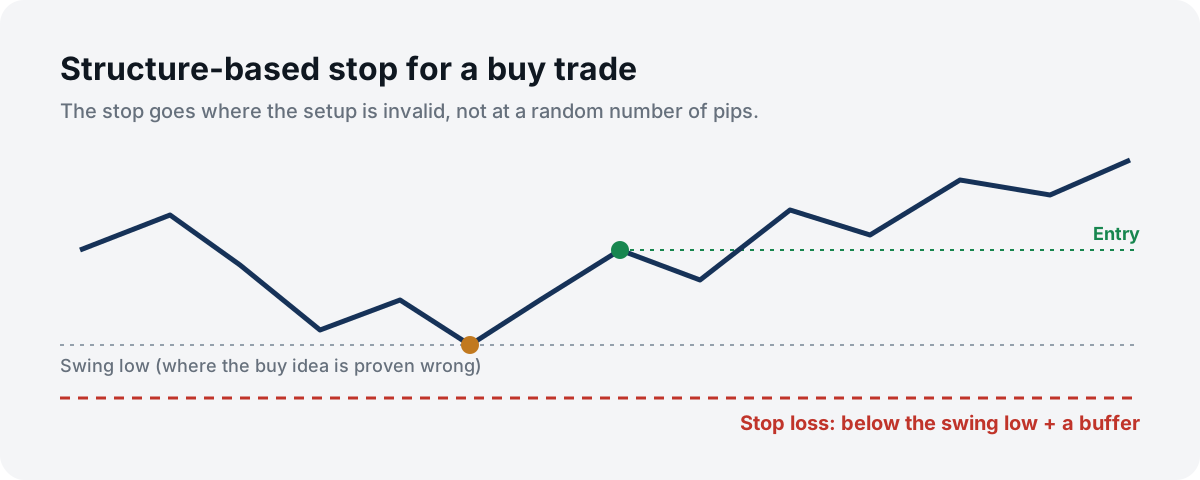
Why does it work? Because if price breaks that swing point, the market structure that made the trade attractive has changed. You're letting the chart, not your nerves, define what "wrong" looks like.
The key words above were a little below. Swing lows are obvious to everyone, which means lots of stops tend to cluster right at them. Price often pokes through those levels briefly before reversing. A small buffer beyond the level — a few pips on most major pairs — keeps you out of that crowd.
Method 2: Volatility — using the ATR
The Average True Range (ATR) is an indicator that measures how much a market typically moves per candle. It's available on virtually every platform and it answers a very practical question: how much does this pair wiggle on a normal day?
A common approach is to place the stop at a multiple of the ATR from your entry — often somewhere between 1 and 2 times.
| 14-period ATR | 12 pips |
| Multiplier | 1.5× |
| Stop distance | 18 pips |
The beauty of ATR stops is that they adapt. When the market is quiet, they tighten up. When volatility spikes around big news, they widen automatically, so a normal-sized move doesn't knock you out. They work especially well combined with Method 1 — check that the ATR distance also puts you beyond a sensible swing point.
Method 3: Support and resistance zones
Similar to structure, but zoomed out. If you're buying near a well-tested support zone, the stop goes below the zone, not below the exact line you happened to draw. Zones are areas, not precise prices — and markets love to test the edges of them.
The same logic applies to round numbers. Levels like 1.1000 or 150.00 attract a lot of orders. Placing your stop exactly at 1.1000 on a buy is like standing in the doorway of a busy shop. Placing it at 1.0985 is usually the calmer choice.
Method 4 (the one to avoid): a fixed number of pips
"I always use a 20-pip stop." It's tidy, it's easy, and it ignores everything the market is telling you. Twenty pips on EUR/USD during a sleepy Asian session and twenty pips on GBP/JPY during a central bank announcement are completely different things. In the first case it might be generous; in the second it's barely noise.
A fixed pip stop has another quiet problem: it rarely lines up with any meaningful level. So you get stopped out at a price that says nothing about whether your trade idea was actually wrong.
The step that ties it all together: size the trade to the stop
Here's the reason many traders resist wider, more sensible stops: they think a wider stop means risking more money. It doesn't have to. Your stop sets the distance; your lot size sets the dollars.
| Tight stop: 15 pips | $50 ÷ (15 × $10) = 0.33 lots |
| Medium stop: 30 pips | $50 ÷ (30 × $10) = 0.16 lots |
| Wide stop: 60 pips | $50 ÷ (60 × $10) = 0.08 lots |
Three different stops, the same $50 at risk. This is the single most freeing idea in risk management: you can put the stop exactly where the chart says it belongs, and keep your risk fixed by adjusting the size. (The full method, including pairs where the pip value isn't $10, is in how to calculate forex position size.)
Once you've placed the stop, look at your target. If the distance to a realistic target isn't worth the distance to the stop, that tells you something about the trade — we explain how to judge that in risk-reward ratio in forex.
A detail that catches out sell trades: the spread
Charts on most platforms show the bid price. But a sell position is closed by buying, at the ask — so its stop is triggered when the ask touches your level. The ask sits above the bid by the size of the spread.
In practice, that means a sell stop placed exactly at a swing high can be hit even though the candles on your chart never touched it. It's especially common at session opens or around news, when spreads widen. Add the typical spread to your buffer on short trades and this mystery stop-out mostly disappears. (No, the broker usually isn't hunting you. It's usually the spread.)
Mistakes that turn good stops into bad ones
- Moving the stop further away once the trade is losing. It feels like giving the trade a chance. It's really raising your risk after the fact, on a trade that's already proving you wrong.
- Mental stops. "I'll close it if it gets to there." In a fast market, with a notification popping up or the kettle boiling, that rarely happens on time. A real order doesn't get distracted.
- Stops that are too tight to survive normal noise. If your stop is inside the pair's usual back-and-forth, you'll get stopped out of good ideas constantly. Check it against the ATR.
- Moving to breakeven too early. It feels safe, but jumping to breakeven after a few pips of profit often turns good trades into scratches. Wait until price has cleared a meaningful level.
- Forgetting gaps. Over a weekend or a major announcement, price can open beyond your stop and fill at a worse level. It's rare, but sizing sensibly means even that worst case is survivable.
Quick answers
How many pips should my stop loss be?
There's no correct fixed number. It depends on the pair, the timeframe and where the setup becomes invalid. Use structure or ATR to find the distance, then size the position to it.
Should I always use a stop loss?
For most retail traders, yes. Leveraged trading without a defined exit point exposes your account to losses that can grow far beyond what you planned.
Is a trailing stop better than a fixed stop?
It's a different tool. A trailing stop follows price to lock in profit as the trade moves your way. It works well in trending markets, less well in choppy ones, where it tends to close trades on ordinary pullbacks.
Why does my stop get hit before price reverses?
Usually because it sits right at an obvious level, inside normal volatility, or (on sells) without allowing for the spread. A small buffer beyond the level fixes most of it.
Placed your stop? Now size it properly
Enter your entry, stop loss and risk % and the calculator gives you the exact lot size, so a wider stop never means risking more than you planned.
Open the Lot Size Calculator →Good stop placement is less about clever tricks and more about honesty: where would this idea be clearly wrong? Put the stop just past that point, let the lot size absorb the distance, and then — this is the hard part — leave it alone. Future you, looking back at the trade with a cup of tea, will be glad you did.