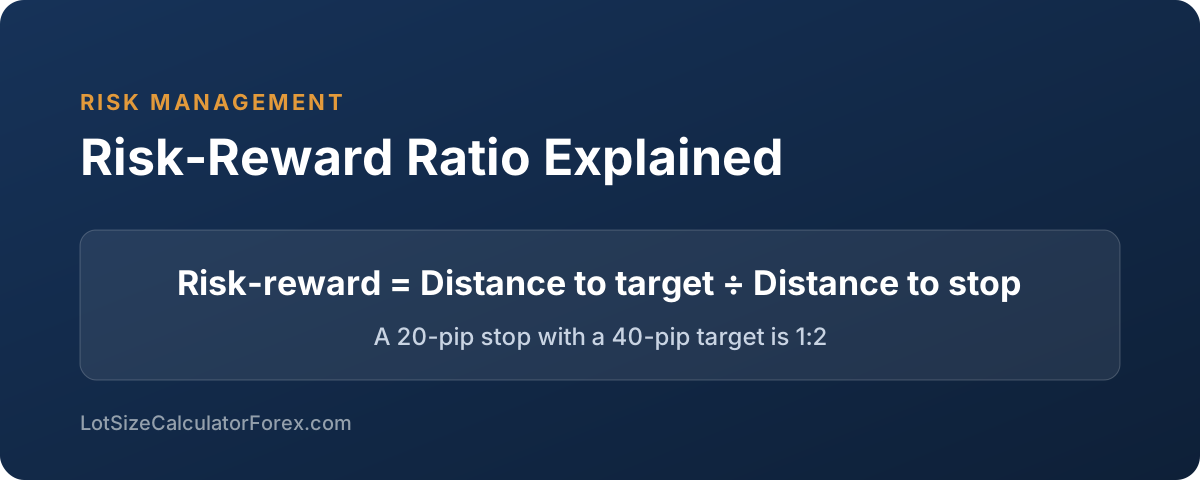
There's a piece of trading advice that gets repeated so often it's almost a reflex: "Never take a trade below 1:2." Maybe you've heard it on YouTube, maybe in a Telegram group, maybe from a friend who's been trading a few months longer than you. It sounds wise. It's also only half the story — and the missing half is where a lot of traders get stuck.
So let's do this properly. What the risk-reward ratio actually measures, the simple maths that tells you whether a ratio is "good," and why chasing a big number on paper can quietly make your results worse.
What is the risk-reward ratio?
The risk-reward ratio compares how much you stand to lose on a trade with how much you stand to gain. It's measured from your entry price to your stop loss (the risk) and from your entry to your take profit (the reward).
Buy EUR/USD at 1.0850, stop at 1.0830, target at 1.0890. The stop is 20 pips away, the target 40 pips. Forty divided by twenty is 2, so this is a 1:2 trade: you're risking one unit to make two.
A quick word on notation, because it confuses people. Most traders write risk first, so 1:2 means "risk 1, make 2." Some platforms and books flip it and call the same trade 2:1. Neither is wrong — just check which way round someone means before you argue with them about it.
It works in money too
Because your lot size is the same on both sides of the trade, the ratio in pips is the ratio in dollars. If that trade is sized to risk $100, it's set up to make $200. That's why the ratio pairs so naturally with position sizing: decide the dollar risk first, and the ratio tells you the dollar reward. (If you haven't nailed the sizing side yet, our guide to calculating forex position size is the place to start.)
The number nobody mentions: your breakeven win rate
Here's the part that makes the risk-reward ratio genuinely useful rather than just a slogan. Every ratio comes with a minimum win rate you need just to break even:
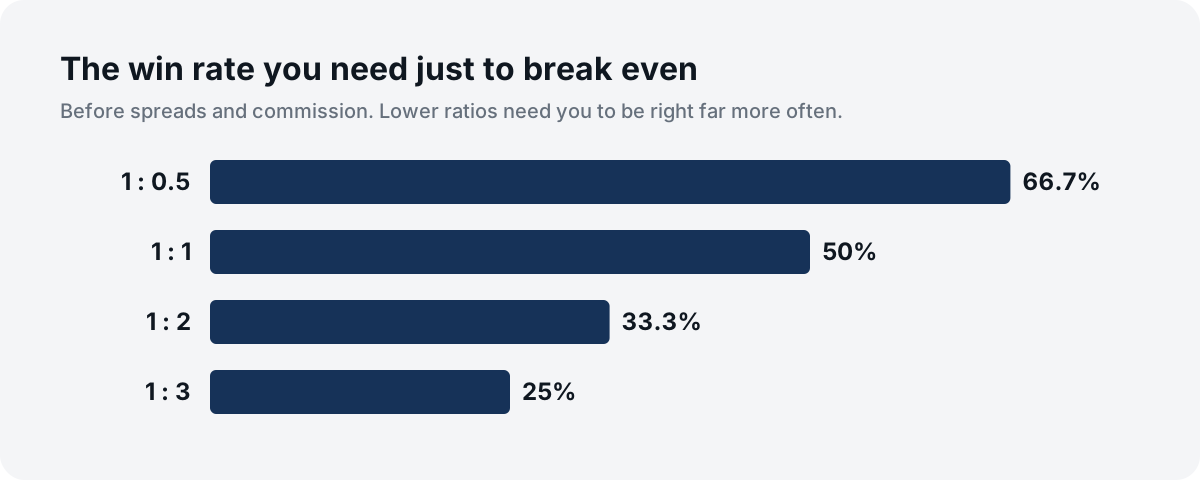
| 1 : 0.5 | 66.7% |
| 1 : 1 | 50% |
| 1 : 1.5 | 40% |
| 1 : 2 | 33.3% |
| 1 : 3 | 25% |
Read that table slowly, because it changes how you think about losing. At 1:2, you can lose two trades out of every three and still not be down. At 1:3, you can be wrong three times out of four. That's a strangely comforting thought on a day when nothing is working.
One caveat: those figures ignore spread and commission. Real costs nudge every breakeven rate a little higher, and the tighter your stop, the bigger that nudge.
Why "always go for 1:3" is not the answer
If 1:3 only needs a 25% win rate, why doesn't everyone just set wide targets and relax?
Because the market doesn't read your trade plan. Moving the target further away doesn't make price travel further — it just makes the target less likely to be reached. Push your take profit from 40 pips to 120 pips on the same setup and you haven't found a better trade. You've found the same trade with a lower chance of paying out.
In other words, risk-reward and win rate are connected. Raise one and the other almost always falls. What you actually care about is the combination of the two, and that has a name.
Expectancy: the number that actually decides whether you make money
Let's compare two very different traders, each risking $100 per trade, over 100 trades.
| Risk-reward | 1:2 ($100 risk, $200 target) |
| Win rate | 40% |
| Winners | 40 × $200 = $8,000 |
| Losers | 60 × $100 = −$6,000 |
| Result | +$2,000 (+$20 per trade) |
| Risk-reward | 1:0.5 ($100 risk, $50 target) |
| Win rate | 70% |
| Winners | 70 × $50 = $3,500 |
| Losers | 30 × $100 = −$3,000 |
| Result | +$500 (+$5 per trade) |
Both are profitable. Trader B wins far more often and probably feels better day to day — but earns a quarter as much, and has almost no margin for error. If B's win rate slips from 70% to 65%, the result goes from +$500 to −$250. A five-point dip in accuracy, and the whole thing flips negative. Trader A could lose that same five points and still be comfortably ahead.
That fragility is the real reason experienced traders lean towards ratios of 1:1.5 or better. It's not that low ratios can't work. It's that they leave so little room for the ordinary bad patches every trader goes through.
How to set a realistic risk-reward on a real trade
The order of operations matters more than people think.
- 1. Place the stop where the idea is wrong. Below the swing low for a buy, above the swing high for a sell — not at a round number you picked because it felt safe. We cover this in detail in where to place your stop loss.
- 2. Find a target the market can actually reach. The next resistance for a buy, the next support for a sell, a recent range high or low. Somewhere price has a genuine reason to go.
- 3. Measure the ratio. If the honest target only gives you 1:0.8, that's information. It doesn't mean you should stretch the target; it might mean you should skip the trade.
- 4. Size the position from the stop. Risk amount ÷ (stop distance × pip value). The ratio doesn't change the lot size — the stop does.
The mistake we see most often is doing this backwards: picking 1:3 first, then dragging the take-profit line to wherever 1:3 lands. The ratio looks great on the chart. The target is sitting in empty space with no reason for price to get there.
Things that quietly change your real ratio
- Spread. You pay it on the way in, so your effective risk is slightly larger and your effective reward slightly smaller than the chart shows. On a 10-pip stop with a 1.5-pip spread, that's not a rounding error.
- Moving your stop further away. The trade turns against you, you give it "a bit more room," and your 1:2 becomes 1:1 without you ever deciding that. It's one of the most human mistakes in trading, and one of the most expensive.
- Closing winners early. Planning 1:2 but nervously taking profit at 1:0.8 does the same damage from the other direction. If you keep doing it, your real ratio is 1:0.8, whatever your plan says.
- Slippage on stops. In fast markets or over weekend gaps, a stop can fill worse than its level. Rare, but it does happen.
Quick answers
What is a good risk-reward ratio in forex?
There's no single magic number, but many traders aim for 1:1.5 to 1:3, because it allows a win rate below 50% and still leaves room for error. What matters is that it's realistic for the setup.
Is 1:1 risk-reward bad?
Not necessarily. You need to win more than half your trades after costs, which some strategies do reliably. It just leaves less margin for bad patches.
Should I use a fixed risk-reward for every trade?
A minimum is useful as a filter ("I don't take trades below 1:1.5"). A fixed target for every trade usually isn't, because every setup has a different nearby support or resistance.
Does risk-reward affect lot size?
No. Lot size comes from your risk amount and stop distance. Risk-reward only tells you what you stand to gain for that same risk.
Plan the risk side in seconds
Enter your balance, risk %, entry and stop loss and the calculator gives you the exact lot size — then your target sets the reward. Works for forex, gold, indices, crypto and stocks.
Open the Lot Size Calculator →The risk-reward ratio isn't a rule to obey; it's a question to ask before every trade: is what I might gain worth what I'm putting on the line, given how often setups like this actually work? Ask it honestly, and you'll pass on some trades you'd otherwise have taken. Quite often, those are the ones you'll be glad you skipped.