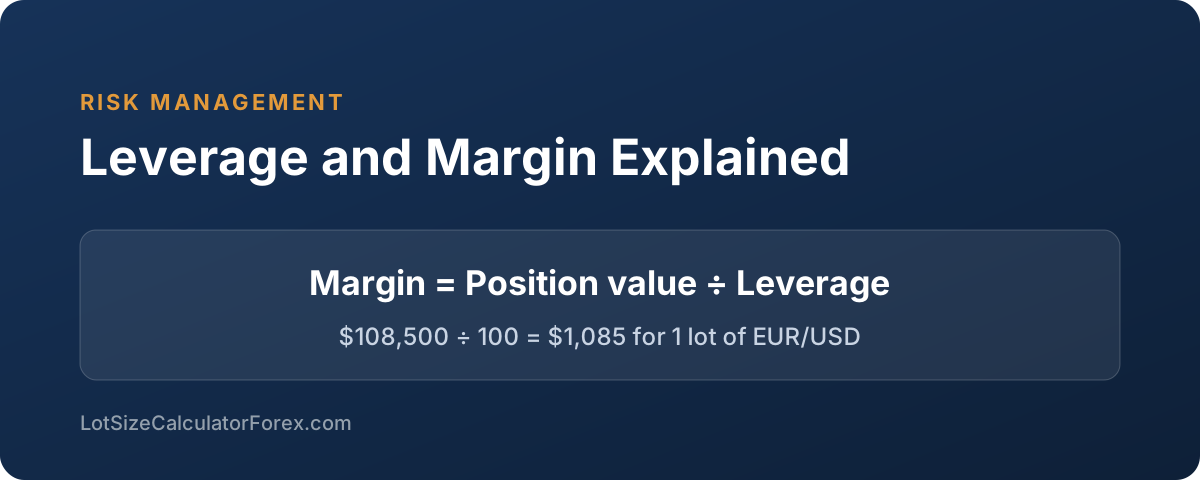
Leverage has a reputation problem. Ask around and you'll hear it's the thing that blows up accounts, that 1:500 is "gambling," and that serious traders only use low leverage. There's a grain of truth buried in there, but most of it is aimed at the wrong target.
Leverage on its own doesn't lose anyone money. What it does is quietly remove the barrier that would have stopped you from taking a position far too big for your account. That's a different problem, with a different fix — and once you see it clearly, both leverage and margin become a lot less scary and a lot more useful.
Leverage in one paragraph
Leverage lets you control a large position with a small deposit. With 1:100 leverage, every $1 of your money can control $100 in the market. Your broker puts up the rest for as long as the trade is open. That's why someone with a $1,000 account can trade a position worth $20,000 or $50,000 — something that would otherwise be impossible.
It exists for a practical reason. Currency pairs move by fractions of a percent on a normal day. Without leverage, you'd need a very large account for those moves to mean anything.
And margin?
Margin is the other side of the same coin. It's the slice of your own money the broker sets aside as a deposit while your trade is open. It isn't a fee, and you don't lose it — it's locked up, then released when you close the position.
Let's put numbers on it. One standard lot of EUR/USD is 100,000 euros. With the pair at 1.0850, that position is worth $108,500.
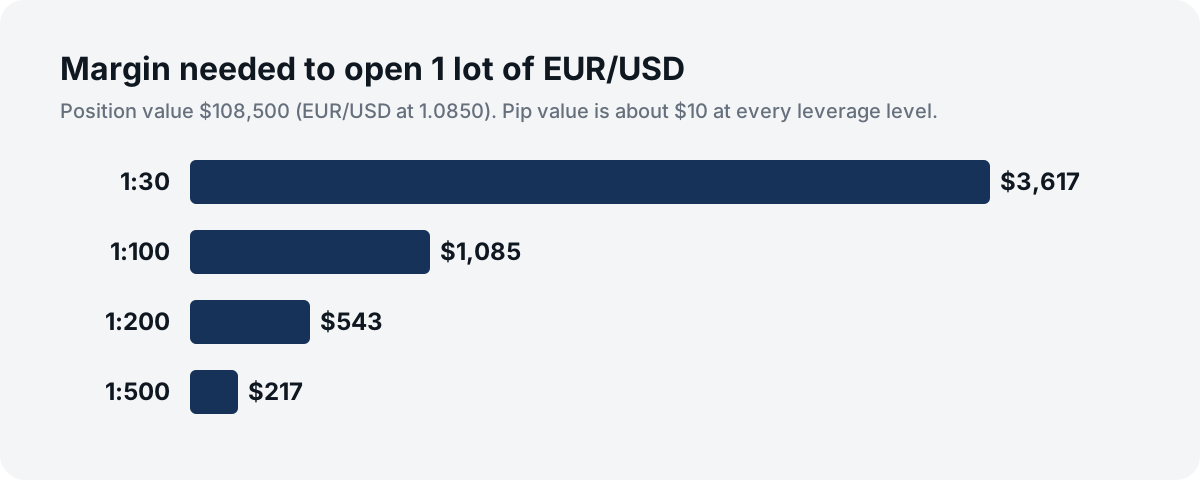
| 1:30 leverage | $3,616.67 |
| 1:100 leverage | $1,085.00 |
| 1:200 leverage | $542.50 |
| 1:500 leverage | $217.00 |
Same trade, same size, same pip value. The only thing leverage changed is how much of your balance gets parked as a deposit.
The idea almost everyone gets backwards
Read that last sentence again, because it's the heart of this whole topic: leverage changes your margin requirement. It does not change your risk per pip.
Picture two traders. Both have $10,000. Both buy 0.25 lots of EUR/USD with a 40-pip stop. One has 1:30 leverage, the other 1:500.
| Margin used at 1:30 | $904.17 |
| Margin used at 1:500 | $54.25 |
| Loss if the stop is hit (either account) | $100 |
| Share of account lost (either account) | 1% |
Identical loss. Identical risk. If you size your trades from your stop loss and your risk percentage — the way we describe in how to calculate forex position size — the leverage setting on your account barely matters day to day.
So where does the danger actually come from?
From what high leverage allows. Here's the scenario that plays out thousands of times a day.
A trader has $1,000 and 1:500 leverage. The platform will happily let them open a full standard lot of EUR/USD, because the margin is only $217. It looks affordable. There's $783 of "free" money left over, after all.
But that position is worth about $10 per pip. A 50-pip move against them — an ordinary Tuesday — is a $500 loss. Half the account, gone on one trade that the platform was perfectly willing to accept.
With 1:30 leverage, the same trader couldn't have opened that trade at all; the margin would have been $3,617. The lower leverage would have acted like a guardrail. That's really all the "low leverage is safer" argument means: it stops you from doing the reckless thing. If you already size your positions properly, you've built that guardrail yourself.
The margin numbers on your platform, decoded
Open the terminal at the bottom of your platform and you'll see a row of figures. They look technical. They're not.
- Balance — your money, counting only closed trades.
- Equity — balance plus or minus whatever your open trades are doing right now. This is the real number.
- Margin (used margin) — the deposit currently locked up by open positions.
- Free margin — equity minus used margin. What's available for new trades.
- Margin level — equity ÷ used margin × 100, shown as a percentage. This is the one your broker watches.
Margin call and stop out
When your margin level falls to a threshold set by the broker, you get a margin call — typically you can no longer open new positions. If it keeps falling to the stop-out level, the broker starts closing your trades automatically, biggest loser first. The exact percentages differ from broker to broker (something like 100% and 50% is common, but check your own account terms — don't take our word for your broker's rules).
Here's how that plays out with a $2,000 account, 1:100 leverage, and one lot of EUR/USD:
| Used margin | $1,085 |
| Margin level at entry | 184% |
| Margin level hits 100% after | about 92 pips against you (−$915) |
| Margin level hits 50% after | about 146 pips against you (−$1,457) |
By the time the broker steps in at 50%, nearly three quarters of the account is gone. That's worth sitting with for a second. A stop out isn't a safety net for you — it exists to protect the broker. Your safety net is your own stop loss, placed long before any of this comes into play.
A more useful number: effective leverage
The leverage on your account is just a ceiling. The figure that tells you what you're actually doing is effective leverage:
That $1,000 trader with one lot open? $108,500 ÷ $1,000 = roughly 108:1. At that level, a 1% move in the market is a 108% move in the account. In other words, less than a 1% move wipes it out.
Compare the $10,000 trader with 0.25 lots: $27,125 ÷ $10,000 = about 2.7:1. A 1% move in EUR/USD changes that account by 2.7%. Uncomfortable, maybe. Fatal, no. If you follow something like the 1% risk rule, you'll find your effective leverage tends to land in single digits without you ever aiming for it.
What leverage should you choose?
In many places, the decision is partly made for you. Regulators in the EU and UK cap retail leverage at 30:1 on major currency pairs (lower on other instruments), Australia applies a similar 30:1 cap, and in the United States the limit is 50:1 on major pairs. Brokers regulated elsewhere may offer 1:500 or more.
If you do have a choice, here's a sensible way to think about it:
- If you size every trade from your stop loss and risk %, moderate leverage such as 1:30 to 1:100 is plenty for most strategies and leaves comfortable free margin.
- If you hold several positions at once, slightly higher leverage gives you room so that margin doesn't block a properly sized trade.
- If you know you're tempted to "just go bigger this once" — be honest with yourself here — lower leverage is a perfectly good way to protect you from that version of you.
None of this is a recommendation for your specific situation; it's simply how the mechanics work. The right setting depends on your strategy, your broker and your own temperament.
Quick answers
Does higher leverage mean higher risk?
Not by itself. Risk comes from position size relative to your account. Higher leverage only makes oversized positions possible.
Can I lose more than my deposit?
In fast markets, prices can gap past your stop and past the stop-out level. Many regulated brokers offer negative balance protection for retail clients, but not all do — check before you fund an account.
Is margin a cost?
No. It's a deposit that's returned when the trade closes. Your actual trading costs are spread, commission and overnight swap.
What's a good margin level to maintain?
There's no official figure, but if your positions are sized at around 1–2% risk each, your margin level will normally sit far above any danger zone. If it's regularly dipping near 200%, your positions are probably too large for the account.
See your margin before you place the trade
The calculator shows lot size, margin required and risk in dollars together, so you know exactly what a trade will tie up — and what it can cost — before you click.
Open the Lot Size Calculator →Leverage is a tool, about as dangerous as a sharp kitchen knife: hugely useful, perfectly safe in careful hands, and unforgiving if you wave it around. Decide your risk first, let the lot size follow from it, and leverage goes back to being what it was always meant to be — a convenience, not a strategy.