"I caught forty pips on cable this morning." If you've spent more than five minutes around traders, you've heard a sentence like that — and if you're new, you probably nodded along while quietly wondering what on earth a pip is, and whether forty of them is a lot.
Fair question. And here's the slightly annoying truth: forty pips can be four dollars or four thousand. The number of pips tells you how far price moved. It tells you nothing about money until you know what each pip is worth. By the end of this guide you'll be able to work out both, on any pair, without guessing.
What is a pip?
A pip is the standard unit for measuring how much a currency pair's price has changed. The name is short for "percentage in point" (some say "price interest point" — honestly, nobody argues about it much).
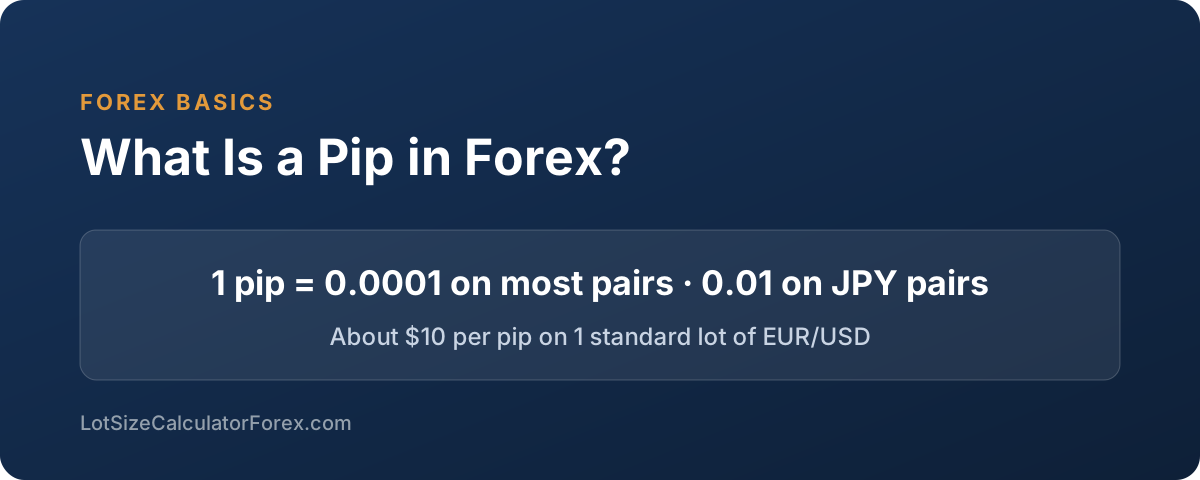
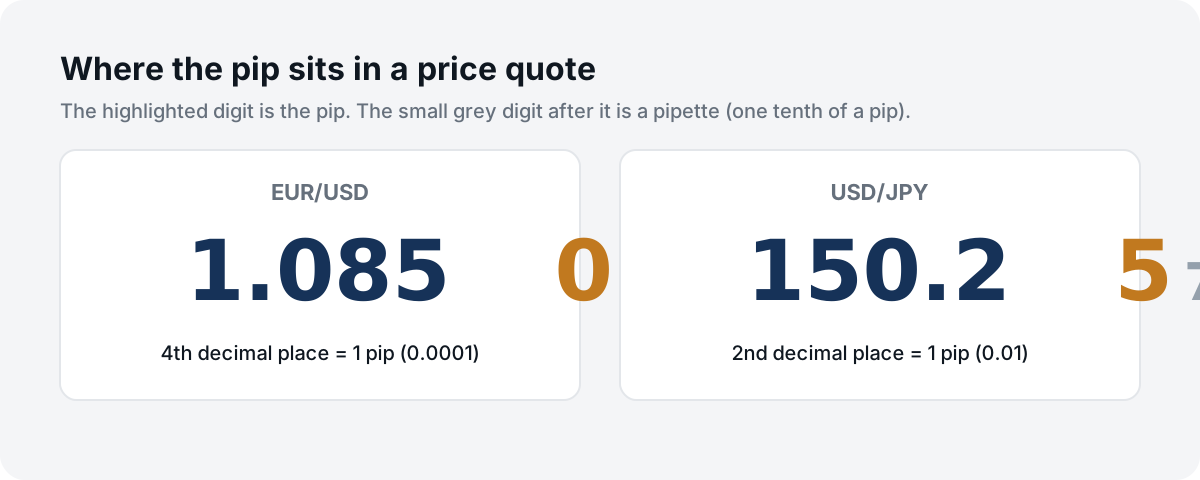
For most currency pairs, one pip is 0.0001 — the fourth decimal place. If EUR/USD goes from 1.0850 to 1.0851, that's one pip. From 1.0850 to 1.0865 is fifteen pips.
The big exception is any pair involving the Japanese yen. Yen pairs are quoted to two decimal places, so one pip is 0.01. USD/JPY moving from 150.20 to 150.65 is forty-five pips.
That extra little digit: pipettes
Look at your platform and you'll notice prices like 1.08503 or 150.257 — one more digit than we just described. That last digit is a pipette, or fractional pip: one tenth of a pip. Brokers added it years ago to quote tighter spreads.
It's useful, but it's also the source of a classic mix-up, which we'll come back to. For now, just train your eye to find the pip digit and ignore the tiny one after it.
How to count pips between two prices
Subtract one price from the other, then divide by the pip size. That's the whole method.
| EUR/USD 1.0850 → 1.0865 | 0.0015 ÷ 0.0001 = 15 pips |
| GBP/USD 1.2700 → 1.2745 | 0.0045 ÷ 0.0001 = 45 pips |
| USD/JPY 150.20 → 150.65 | 0.45 ÷ 0.01 = 45 pips |
| EUR/JPY 162.80 → 162.10 | 0.70 ÷ 0.01 = 70 pips (down) |
After a week or two you stop doing the division. You just read the digits, the way you read a clock without counting the minute marks.
Pip value: turning pips into money
This is the bit that actually matters for your account. Pip value answers the question: if price moves one pip, how much do I make or lose?
It depends on two things — the size of your trade and which pair you're trading.
The answer comes out in the quote currency, the second currency in the pair. That detail is where most of the confusion comes from, so let's take the three cases one at a time.
Case 1: USD is the quote currency (EUR/USD, GBP/USD, AUD/USD)
The easy one. One standard lot is 100,000 units, so:
0.0001 × 100,000 = $10 per pip.
Always. It doesn't matter whether EUR/USD is trading at 1.05 or 1.15. Scale it down and you get the numbers worth memorising:
| 1.00 lot (standard) | $10 per pip |
| 0.10 lot (mini) | $1 per pip |
| 0.01 lot (micro) | $0.10 per pip |
(Not sure what those lot sizes mean? Start with what a lot is in forex and come back.)
Case 2: USD is the base currency (USD/JPY, USD/CAD, USD/CHF)
Here the pip value comes out in the other currency, so you have to convert it back. Take USD/JPY at 150.00:
0.01 × 100,000 = ¥1,000 per pip. Divide by the exchange rate: ¥1,000 ÷ 150.00 = about $6.67 per pip.
And notice — it moves. If USD/JPY drops to 140.00, the same pip is worth ¥1,000 ÷ 140 = $7.14. That's a 7% difference in what each pip costs you, on the same lot size. People who assume "a pip is ten bucks" on yen pairs end up with positions that are simply the wrong size.
Case 3: No USD at all (EUR/GBP, EUR/JPY, GBP/AUD)
Same idea, one more step. On EUR/GBP, one pip on a standard lot is £10. To see that in dollars, multiply by GBP/USD. At 1.2700, that's $12.70 per pip — noticeably more than on EUR/USD.
You can do all of this by hand, and it's worth doing once or twice so you understand it. After that, let a calculator fetch the conversion — that's precisely the kind of arithmetic that goes wrong at 7 a.m. before coffee.
Pips vs points: the mix-up that costs real money
Remember the pipette? On MetaTrader and many other platforms, the smallest price step is called a point, and on a five-digit quote one pip equals ten points.
So when a platform asks for a stop loss "in points" and you type 50 thinking of fifty pips, you've actually set a 5-pip stop. It gets hit almost instantly, and you're left staring at the screen wondering what just happened. The opposite error is worse: an expert advisor or script set to 500 "pips" that really means 500 points behaves nothing like you planned.
The fix is boring but effective. Whenever a field says points, multiply your pips by ten. And the first time you use any new tool, test it on a demo account.
What about gold, indices and crypto?
Strictly speaking, pips are a forex idea. Other markets borrow the word loosely, and — this is the frustrating part — brokers don't agree on the definition.
On gold (XAU/USD), some brokers call a $0.10 move a pip, others call $0.01 a pip. With a standard 100-ounce lot, a $0.10 move is worth $10 and a $0.01 move is worth $1. Ten times apart, same word. Indices are usually measured in points, and crypto in plain dollars.
Our advice: on anything that isn't a currency pair, stop thinking in pips. Think in price distance — "my stop is $8 away on gold" — and let the contract size do the rest. It's much harder to fool yourself that way.
Spread is measured in pips too
Every trade starts slightly in the red because of the spread — the gap between the buy and sell price. If EUR/USD shows 1.08500 / 1.08512, the spread is 1.2 pips.
In money terms, on 0.50 lots that's 1.2 × $5 = $6 paid the moment you click. Not dramatic on one trade. But take ten trades a day and it's $60 a day, which adds up to a real number by the end of the month. Scalpers with 5-pip targets feel this the most: a 1.2-pip spread is nearly a quarter of the target gone before the trade even starts.
Why pips sit at the centre of position sizing
Here's where it all connects. Your stop loss is a distance in pips. Your risk is an amount in dollars. Pip value is the bridge between the two:
Say you'll risk $50, with a 25-pip stop on EUR/USD. That's $50 ÷ (25 × $10) = 0.20 lots. Change the pair to USD/JPY at 150.00 and the pip value becomes $6.67, so the answer becomes $50 ÷ (25 × $6.67) = 0.29 lots (0.2999 rounded down). Same risk, same stop, different lot size — purely because the pip is worth less.
We walk through that process step by step in how to calculate forex position size.
Quick answers
How much is 1 pip worth?
On pairs quoted in USD: $10 on a standard lot, $1 on a mini lot and $0.10 on a micro lot. On other pairs it varies with the exchange rate.
How much is 100 pips worth?
On EUR/USD: $1,000 on 1.00 lot, $100 on 0.10 and $10 on 0.01.
Is a pip the same as a point?
Usually not. On five-digit quotes, one pip is ten points.
How many pips does EUR/USD move in a day?
It changes with market conditions — quiet days can be well under 50 pips, and days with major news can be well over 100. Check the recent average range on your own platform rather than trusting a fixed number.
Skip the pip maths
The calculator works out pip value and lot size together for any pair, including yen crosses, gold and indices — just enter your entry, stop loss and risk.
Open the Lot Size Calculator →Once pips make sense, a lot of trading talk suddenly gets clearer. "Forty pips" stops sounding like bragging or jargon and becomes what it is: a distance. What that distance is worth is up to you, and that choice — the lot size — is the one that really counts.