Almost everyone meets the word "lot" the same way. You open a trading platform for the first time, see a little box labelled Volume, type a nice round "1" into it, and hit buy. A few seconds later the market twitches twelve pips the wrong way and your balance is down $120. Wait, what?
That moment — equal parts confusion and mild panic — is what this guide is for. A lot isn't complicated. It's just badly explained, usually by a platform that assumes you already know. So let's fix that properly, with real numbers, and without pretending it's rocket science.
So what is a lot, exactly?
A lot is simply the unit forex uses to measure trade size. Instead of saying "I'd like to buy 100,000 euros, please," traders say "one lot." That's all it is: a standardised bundle of currency.
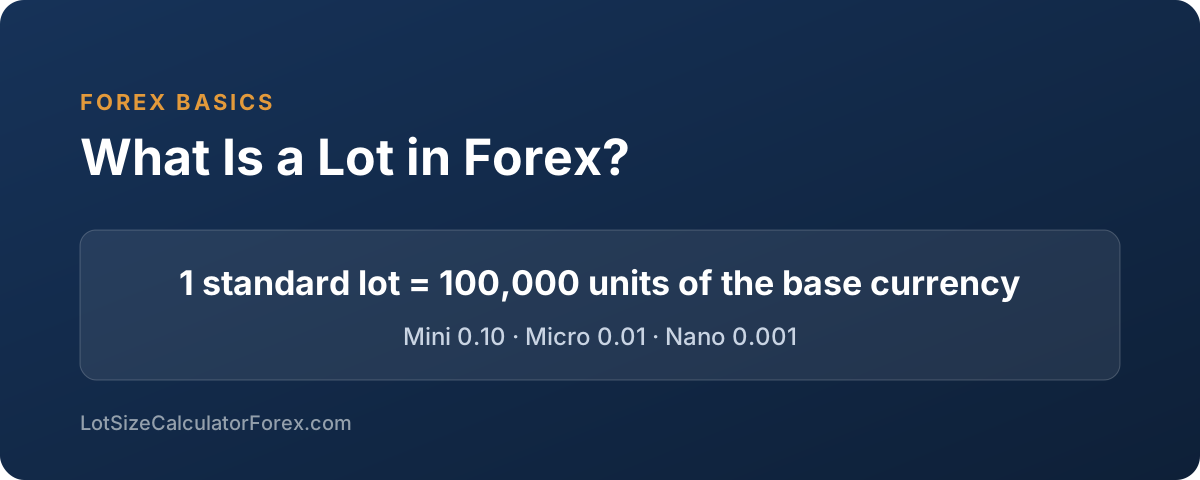
One standard lot is 100,000 units of the base currency — the first currency in the pair. So one lot of EUR/USD is 100,000 euros. One lot of GBP/JPY is 100,000 pounds. One lot of USD/CAD is 100,000 US dollars.
Why such a huge number? Because currencies move in tiny increments. EUR/USD drifting from 1.0850 to 1.0860 is a perfectly normal move, and it's a change of one tenth of a cent. On a €100 trade that would earn you about ten cents. Nobody's building a trading career on ten cents, so the market trades in big blocks where those small moves actually add up to something.
The four lot sizes you'll actually see
Thankfully you don't have to trade a full 100,000 units. Brokers slice the standard lot into smaller pieces, and those pieces are where most retail traders live.
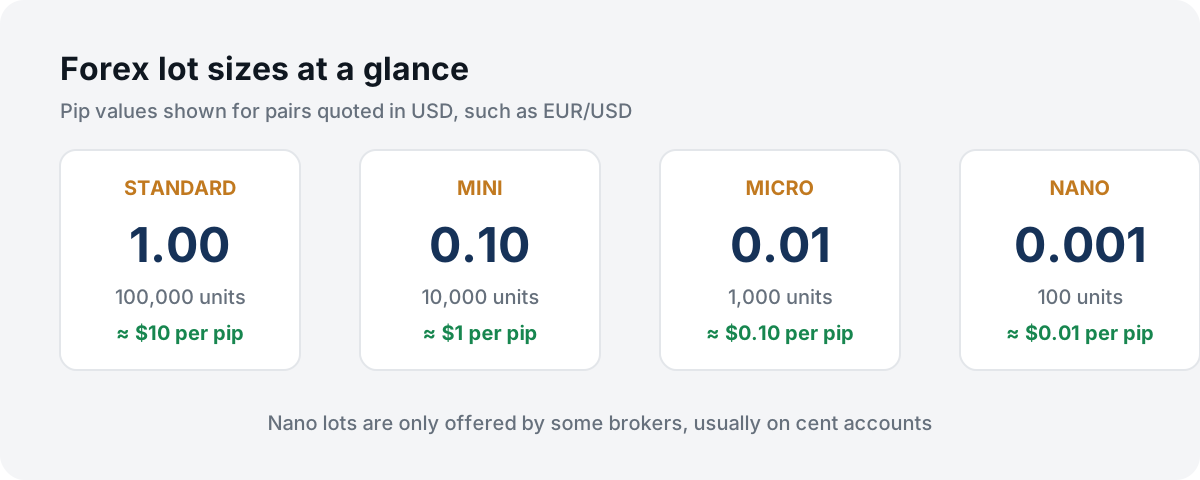
| Standard lot — 1.00 | 100,000 units · about $10 per pip |
| Mini lot — 0.10 | 10,000 units · about $1 per pip |
| Micro lot — 0.01 | 1,000 units · about $0.10 per pip |
| Nano lot — 0.001 | 100 units · about $0.01 per pip |
A couple of honest notes on that table. The pip values are for pairs where the US dollar is the second currency — EUR/USD, GBP/USD, AUD/USD and so on. For pairs like USD/JPY or EUR/GBP the value per pip is a little different, and it shifts as prices move. We go through that properly in our guide to what a pip is and how pip value works.
And nano lots? They exist, but not everywhere. You'll mostly find them on "cent" accounts. Most brokers stop at 0.01, which is the smallest size you can type into the volume box.
Reading the volume box
This trips up more people than it should, so let's be explicit. The number in your platform is measured in standard lots:
- 1.00 = one standard lot (100,000 units)
- 0.10 = one mini lot (10,000 units)
- 0.01 = one micro lot (1,000 units)
- 0.25 = two mini lots and five micro lots (25,000 units)
That last one matters. You're not stuck choosing between "mini" and "standard" like sizes on a coffee menu. You can trade 0.07, 0.25, 1.38 — any multiple of your broker's minimum step.
Why lot size is the thing that decides your profit or loss
Here's the part that makes it click for most people. The market doesn't care how big your trade is — it moves the same number of pips either way. What changes is how much each of those pips is worth to you, and that's set entirely by lot size.
Take a 30-pip move against you on EUR/USD:
| 1.00 lot | −$300 |
| 0.50 lots | −$150 |
| 0.10 lots | −$30 |
| 0.01 lots | −$3 |
Same chart. Same entry. Same stop. One trader shrugs off three dollars; another has just lost three hundred. On a $1,000 account, that 1.00-lot trade wiped out 30% of the balance in one go. This is why experienced traders tend to obsess over size far more than over entries. A mediocre entry with sensible size is survivable. A brilliant entry with reckless size, sooner or later, isn't.
Which lot size should you use for your account?
The honest answer: you don't pick a lot size. You calculate it. The lot size is the output, not the starting point.
You start with two decisions — how much of your account you're willing to lose on this trade, and where your stop loss has to go — and the lot size falls out of those. The formula is short:
To make that less abstract, here's what it produces for different account sizes, all risking 1% with a 20-pip stop on EUR/USD:
| $100 account (risk $1) | 0.005 → below the 0.01 minimum |
| $500 account (risk $5) | 0.02 lots |
| $1,000 account (risk $10) | 0.05 lots |
| $5,000 account (risk $50) | 0.25 lots |
| $10,000 account (risk $100) | 0.50 lots |
Look at that first row, because it's a real problem small accounts run into. With $100, even the smallest position most brokers allow (0.01 lots) risks $2 on a 20-pip stop. That's 2%, not 1%. It's not the end of the world, but you should know it's happening rather than discover it later. Your options are a tighter stop, a cent account with nano lots, or accepting slightly higher risk per trade with your eyes open.
If you want the full walkthrough of that formula, including a USD/JPY example where the pip value isn't a neat $10, it's all in how to calculate forex position size. And if you're wondering whether 1% is the right number to begin with, we looked at the maths behind it in the 1% risk rule explained.
Lots aren't the same thing on gold, indices and crypto
This one catches out even people who've traded forex for a while. The word "lot" is reused across instruments, but the amount inside the lot changes completely.
- Gold (XAU/USD): one lot is usually 100 troy ounces. A $1 move in the gold price is $100 per lot. So 0.10 lots with a $10 stop is a $100 risk — gold moves $10 before lunch on a quiet day.
- Silver (XAG/USD): commonly 5,000 ounces per lot.
- Indices: it depends on the broker. One lot might be worth $1 per index point at one broker and $10 at another. Same name, ten times the exposure.
- Crypto: often one lot equals one coin, but again, this varies.
The habit worth building: before trading anything new, open the instrument's specification in your platform and look for contract size. It takes ten seconds. Skipping it is how people accidentally take a position five times bigger than they meant to.
The mistakes we see again and again
- Typing 1 instead of 0.1. It sounds silly. It happens constantly, usually when someone's rushing to catch a move.
- Using the same lot size on every trade. "I always trade 0.10" feels disciplined, but a 15-pip stop and a 60-pip stop at the same size are wildly different risks. Fixed lots means your risk is being chosen by the chart, not by you.
- Sizing up to "win it back." After a loss, doubling the lot feels like the fastest way home. It's also the fastest way to turn a bad day into a bad month.
- Rounding up. If the maths says 0.127, the answer is 0.12, not 0.13. Rounding up means risking more than you decided to.
- Assuming a lot means the same on every instrument. See gold, above. Ouch.
Quick answers
How much is 0.01 lot in dollars?
0.01 lot is 1,000 units of the base currency. On EUR/USD each pip is worth roughly $0.10, so a 50-pip move is about $5 either way.
How much money do I need to trade one standard lot?
The margin to open it depends on your leverage — a few hundred dollars at high leverage. But that's the wrong question. At about $10 a pip, a normal 30-pip stop risks $300, so to keep that at 1% you'd want roughly $30,000 in the account. More on that in leverage and margin explained.
Is a bigger lot size better?
Bigger lots mean bigger wins and bigger losses, in exact proportion. They don't improve your odds one bit. The right size is the one that keeps a losing trade boring.
What's the smallest lot size I can trade?
At most brokers it's 0.01 (a micro lot). Some cent accounts go down to 0.001.
Get your exact lot size in seconds
Enter your balance, risk %, entry and stop loss, and the calculator works out the right lot size for forex, gold, indices, crypto or stocks — instantly, in your browser.
Open the Lot Size Calculator →Lots stop being intimidating the moment you see them for what they are: a volume dial. Turn it up and every pip counts for more; turn it down and every pip counts for less. Decide what a loss is allowed to cost first, set the dial second, and you're already doing what most new traders never get around to.