Indices are where a lot of forex traders go next. US30 and NAS100 move fast, they trend beautifully on a good day, and the New York open can feel like someone switched the market on. They're also where a surprising number of traders take their biggest accidental loss — not because their analysis was wrong, but because they typed in a lot size that meant something completely different from what they thought.
If you've ever placed "just 1 lot" on NAS100 and then watched the profit and loss number jump around like a heart monitor, you know exactly what we mean. Let's make index sizing boring and predictable, which is exactly how it should be.
First, a quick map of the names
Brokers use their own labels for index CFDs, but the common ones are:
- US30 — the Dow Jones Industrial Average (sometimes called DJ30 or WS30)
- NAS100 — the Nasdaq 100 (also US100, USTEC)
- US500 — the S&P 500 (also SPX500)
- GER40 — Germany's DAX (formerly GER30)
- UK100 — the FTSE 100
Different names, same idea: you're trading the price movement of the index, measured in points.
Points, not pips
Indices don't use pips. They move in points, and one point is usually a move of 1.0 in the index price. If US30 rises from 42,000.0 to 42,150.0, that's 150 points. (Prices here are illustrative — the maths works the same at any level.)
Small warning: a few platforms show an extra decimal and call the smallest step a "point" too, so a 1.0 move could appear as 10 "points" in some order fields. If a stop you enter in points behaves strangely, that's the first thing to check.
The thing that changes everything: value per point
Here's the part that catches people out. On forex, one standard lot is 100,000 units nearly everywhere. On indices, there is no universal lot size. Each broker decides what one lot is worth per point.
- At some brokers, 1 lot of US30 = $1 per point.
- At others, 1 lot = $10 per point.
- Some use other contract sizes entirely, and the value can differ between account types at the same broker.
That's a tenfold difference hiding behind the same word. Before you size any index trade, open the instrument's specification in your platform and find the contract size or value per point. Write it down. It takes ten seconds and it's the most important number in this whole article.
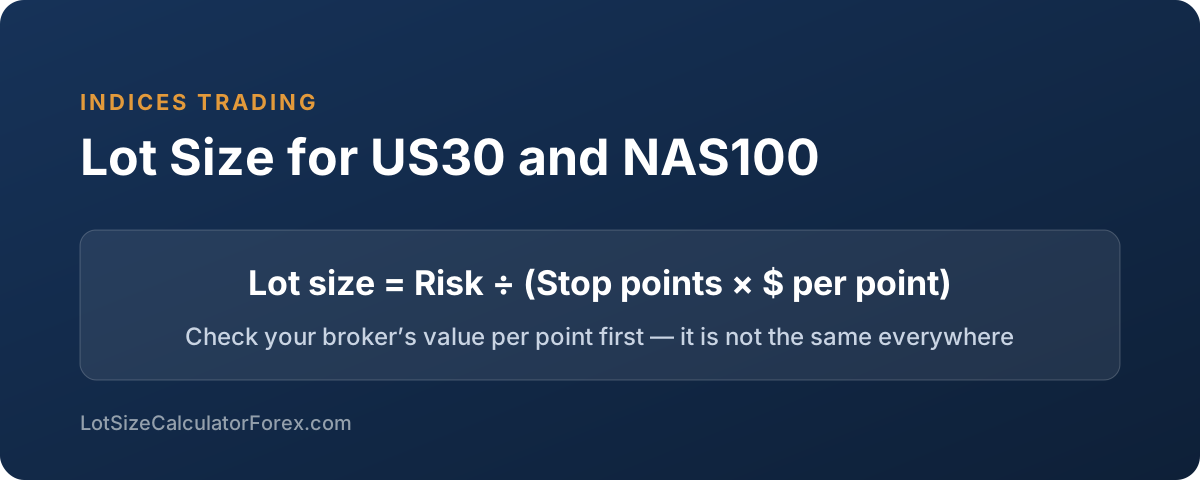
The formula
If you've read our guide to calculating forex position size, this will look very familiar. It's the same logic — points simply replace pips, and value per point replaces pip value.
Worked example 1: US30
You have a $10,000 account and risk 1%, so $100. You want to buy US30 with a stop 150 points below your entry.
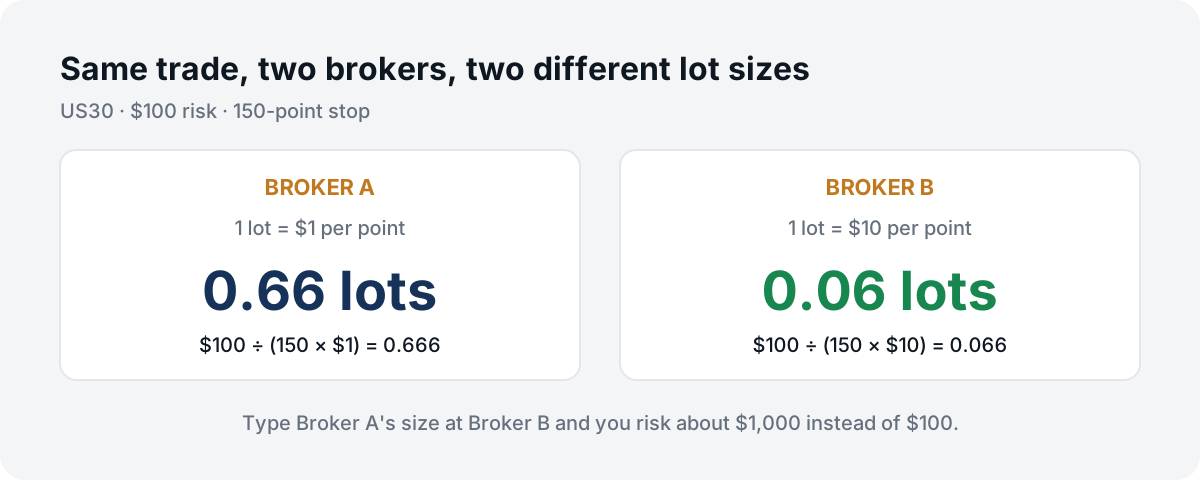
| Broker A: 1 lot = $1 per point | $100 ÷ (150 × $1) = 0.66 lots |
| Broker B: 1 lot = $10 per point | $100 ÷ (150 × $10) = 0.06 lots |
Same chart, same stop, same $100 risk — and lot sizes that differ by a factor of ten. Now imagine someone who learned on Broker A, moves to Broker B, and keeps typing 0.66. Their "1% trade" is now roughly a 10% trade. Nothing about their strategy changed. Just the contract.
And as always, round down. 0.666 becomes 0.66, not 0.67.
Worked example 2: NAS100
A $5,000 account risking 1% ($50), selling NAS100 with a 60-point stop, at a broker where 1 lot = $1 per point:
| Risk amount | $50 |
| Stop distance | 60 points |
| Value per point (1 lot) | $1 |
| Calculation | $50 ÷ (60 × $1) = 0.833 |
| Position size | 0.83 lots |
Because it's a sell, your stop is triggered by the ask price, which sits above the chart's bid price by the spread. Index spreads can widen sharply around the market open and big data releases, so give short-trade stops a little extra room. We go into why in where to place your stop loss.
Why indices feel so "big"
Index prices are large numbers, and they move in large numbers. A 100-point move on US30 or NAS100 in a single session isn't unusual, especially around the US cash open or major economic data. On a 1-lot position at $10 per point, that's $1,000 — possibly in minutes.
That's not a reason to avoid indices. It's a reason to size from your stop every single time, rather than from habit. Fixed lot sizes are risky in forex; on indices they're asking for trouble.
Margin on indices
Margin works the same way as on forex — position value divided by leverage — but leverage on indices is usually lower. In the EU, UK and Australia, retail leverage on major indices is commonly capped at 20:1, and many brokers elsewhere also offer less leverage on indices than on currency pairs.
Position value is the index price × the value per point × your lot size. At Broker B, 0.06 lots of US30 at 42,000 is 42,000 × $10 × 0.06 = $25,200. At 20:1, that ties up $1,260 of margin. As always, margin is a deposit, not your risk — the stop and lot size decide what you can lose. More in leverage and margin explained.
Index-specific things to watch
- The cash open. US indices often move hard right after the New York stock market opens. Spreads can be wider just before and during that moment.
- Gaps. Index CFDs often pause overnight or over the weekend. Price can open well beyond your stop, filling it at a worse level than planned.
- Earnings season. NAS100 in particular is heavily influenced by a small number of large tech companies. Their results can move the whole index.
- Overnight financing. Holding index CFDs overnight usually incurs a financing charge. Small per day, noticeable over weeks.
- Different trading hours. Each index has its own schedule, and it can change around holidays. Your platform's specification shows them.
Mistakes we see most often
- Assuming 1 lot means the same everywhere. The big one. Always check value per point.
- Copying a lot size from someone else's screenshot. Their broker's contract may be ten times different from yours.
- Using forex-sized stops. A 20-point stop on NAS100 is often just noise. Check the ATR on your timeframe.
- Trading the open with full size. If you trade those first minutes, consider a smaller risk percentage until you've seen how your strategy handles them.
Quick answers
How much is 1 lot of US30?
It depends on your broker. Commonly $1 or $10 per point per lot, but always check the contract specification.
How much is 0.01 lot on NAS100?
At a broker where 1 lot = $1 per point, 0.01 lot is $0.01 per point — a 100-point move is $1. At $10 per point, it's $0.10 per point.
Is US30 more volatile than forex?
In absolute numbers it moves much more, which is why per-lot risk tends to be bigger. Sized correctly from your stop, an index trade can risk exactly the same dollar amount as a forex trade.
What's the minimum lot size on indices?
Often 0.01 or 0.1, depending on the broker and the index. It's listed in the specification.
Size your index trade in seconds
Choose your index, enter your balance, risk %, entry and stop loss, and the calculator works out the lot size — so a new broker or a new index never surprises you.
Open the Lot Size Calculator →Index trading has a reputation for being wild, and on the busiest days it can feel that way. But the maths underneath it is calm and simple: know your value per point, measure your stop, divide. Do that every time and the wildness stays on the chart, where it belongs — not in your account balance.