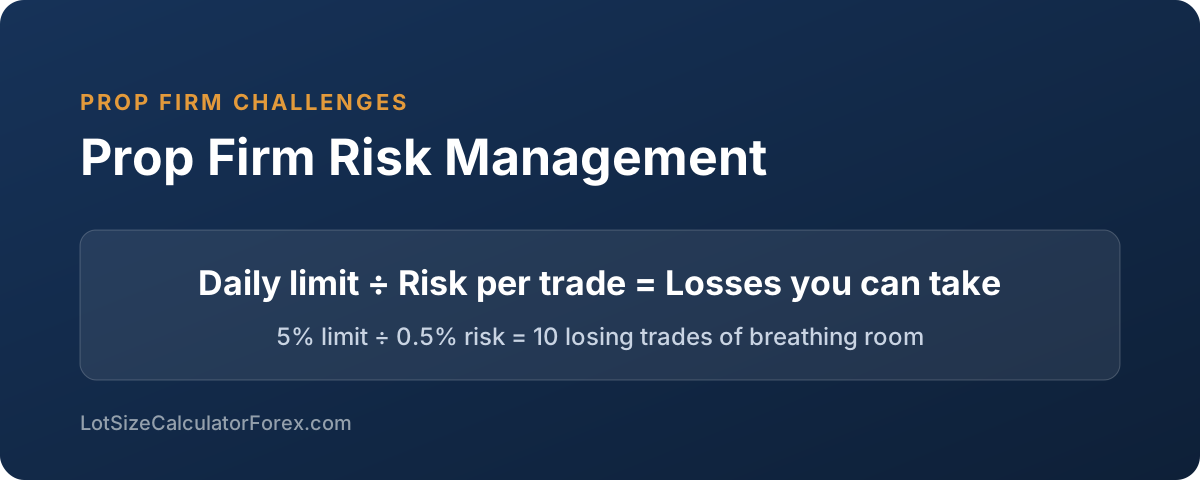
Most failed prop firm challenges don't fail because the trader couldn't read a chart. They fail on a Tuesday afternoon, after two losses, when someone decides the third trade needs to be bigger "to get back on track." Twenty minutes later the daily loss limit is gone, and so is the account fee. If that story sounds uncomfortably familiar, you're far from alone — it's probably the most common way challenges end.
The rules of a funded challenge aren't really a test of how much you can make. They're a test of whether you can avoid losing too much, too fast. That's a position sizing problem, and position sizing problems have maths-based answers. Let's go through them.
A quick note before we start: every firm sets its own rules, and they change. The numbers below are typical examples to explain the mechanics — always read your own firm's current terms.
The rules that actually end challenges
Prop firms vary, but most challenges are built around a few common rules:
- Profit target — reach a set gain (often somewhere around 8–10% in the first phase) to pass.
- Daily loss limit — a maximum you can lose in a single day, frequently around 5% of the starting balance.
- Maximum drawdown — a hard floor for the whole account, frequently around 10%.
- Extra conditions — minimum trading days, consistency rules, or restrictions around news, depending on the firm.
Notice something? Only one of those rules is about making money. The others are all about how you lose. That's where your attention should go.
Know exactly how your firm measures losses
"5% daily loss" sounds clear until you read the small print. Firms measure it differently, and the difference matters:
- From the starting balance or from the day's starting equity? If you finished yesterday with open trades in profit, some firms count today's limit from that higher equity figure.
- Closed trades only, or floating losses too? At many firms, an open trade that's temporarily down counts towards the limit — even if it later recovers. Touch the line once, and that can be enough.
- Static or trailing maximum drawdown? A static drawdown stays fixed (for example, the account can never drop below $90,000 on a $100,000 challenge). A trailing one moves up as your account makes new highs.
Why trailing drawdown deserves extra respect
Say you have a $100,000 account with a $5,000 trailing drawdown. At the start, the floor is $95,000. You have a great week and your equity peaks at $104,000 — the floor moves up to $99,000. Now a normal $5,000 pullback, which would have been fine on day one, ends the account. Profits shrink your breathing room rather than adding to it, until (at some firms) the floor locks in place.
The core idea: count your losses, not your wins
Here's the simplest, most useful calculation for any challenge:
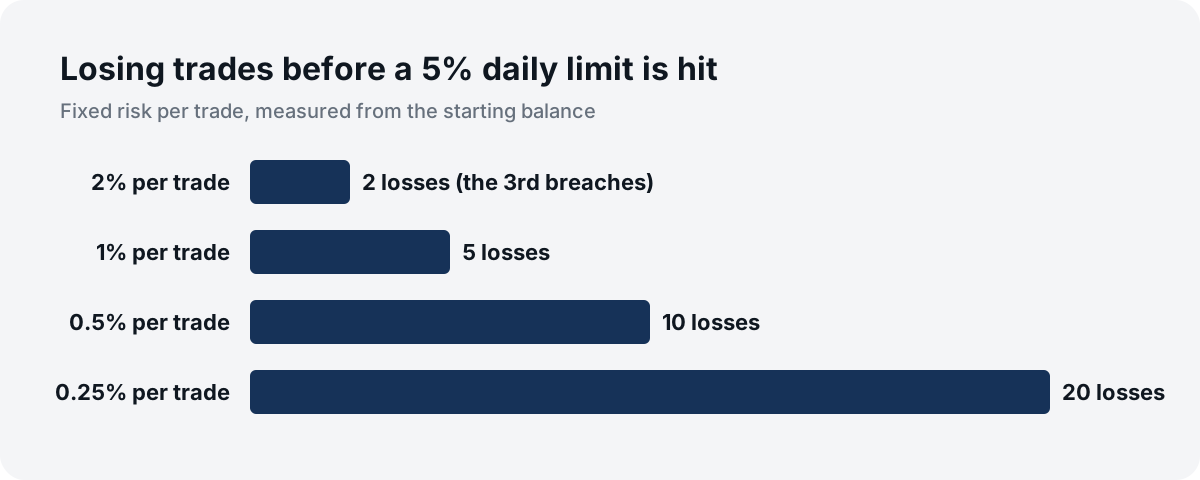
| 2% risk per trade ($2,000) | 2 losses a day · 5 losses in total |
| 1% risk per trade ($1,000) | 5 losses a day · 10 losses in total |
| 0.5% risk per trade ($500) | 10 losses a day · 20 losses in total |
| 0.25% risk per trade ($250) | 20 losses a day · 40 losses in total |
(Strictly, at 2% the third loss in a day takes you to 6%, past the limit — so it's really "two and done.")
Now the uncomfortable question: how many losses in a row should you expect? We ran a simple simulation of a strategy that wins 45% of the time, over 200 trades. A streak of 6 losses in a row showed up in about 93% of runs. A streak of 8 happened in roughly half of them. That's not a bad strategy — that's an ordinary one doing ordinary things.
Lay that against the table. At 2% risk, a perfectly normal six-trade losing streak blows through the maximum drawdown. At 0.5%, the same streak costs 3% — annoying, but survivable. This is the single biggest reason experienced challenge traders tend to risk well under 1% per trade. (We dig into the maths of losing streaks in the 1% risk rule explained.)
"But won't small risk make the target impossible?"
It's the fair objection, and it's what tempts people to size up. So let's check it.
Say you risk 0.5% per trade with an average risk-reward of 1:2, and win 45% of the time. Each win is +1%, each loss −0.5%. Over 20 trades: 9 wins × 1% = +9%, 11 losses × 0.5% = −5.5%. Net: +3.5%. Over 50 trades, around +8.75%.
So yes, it takes more trades. But you're far more likely to still be in the game when the good run arrives. Most firms now give generous time — or no time limit at all — precisely because rushing is what makes people fail. If you want to sanity-check your own numbers, our guide to risk-reward and expectancy walks through the formula.
A practical sizing plan for a challenge
- Pick a fixed risk per trade before you start. Many traders choose 0.25%–0.5%. Write it down.
- Set a personal daily stop well inside the firm's limit. If the firm allows 5%, stop for the day at 2%. You'll never touch the real line.
- Calculate the lot size from the stop on every trade. Never from habit, never from the last trade. The full method is in how to calculate forex position size.
- Count open trades together. Three trades at 0.5% each on correlated pairs (say, EUR/USD, GBP/USD and AUD/USD long) is closer to one 1.5% trade on "the dollar."
- Reduce risk after a losing streak, not after a win. Dropping from 0.5% to 0.25% after three losses slows the bleeding while you reassess.
- Check the news calendar. Even if your firm allows news trading, spreads widen and stops can slip. Plan for it.
The psychological trap nobody warns you about
Challenges have a fee, and paying it changes how people trade. The money feels "already spent," so taking a big swing feels free. Or the opposite: a trader gets close to the target and freezes, taking nothing for days, then rushes a mediocre setup to finish. Both are completely human. Both come from treating the challenge as a lottery ticket instead of a process.
The traders who pass consistently tend to be almost boring about it. Same risk, same routine, same daily stop. They treat the challenge account as if it were already their real funded account — which, if they keep trading like that, it soon will be.
Quick answers
What's a good risk per trade for a prop firm challenge?
There's no official figure, but many traders use 0.25%–0.5%, so that a normal losing streak stays far away from the daily and overall limits.
Does a floating loss count towards the daily limit?
At many firms, yes — equity, including open trades, is what's measured. Check your firm's rules.
How do I calculate lot size for a $100,000 challenge?
Exactly like any other account: risk amount ÷ (stop distance × pip or point value). At 0.5% risk with a 25-pip stop on EUR/USD, that's $500 ÷ (25 × $10) = 2.00 lots.
Should I trade bigger to pass faster?
Bigger size makes passing faster if it works and failing far more likely if it doesn't. Over many attempts, smaller and steadier usually wins.
Size every challenge trade exactly
Enter your challenge balance, your risk %, entry and stop loss, and get the precise lot size for forex, gold, indices or crypto — so no single trade can threaten your limits.
Open the Lot Size Calculator →A prop challenge rewards one thing above all: still being there at the end. Get your risk per trade small enough that your worst normal week is boring, and let the profit target take care of itself. It's slower. It's less exciting. And it's how most funded traders got funded.